Research
Historical Reference or Contemporary Fantasy?
A practical method for separating documented objects, stage evidence, formal inspiration and entirely new character art.
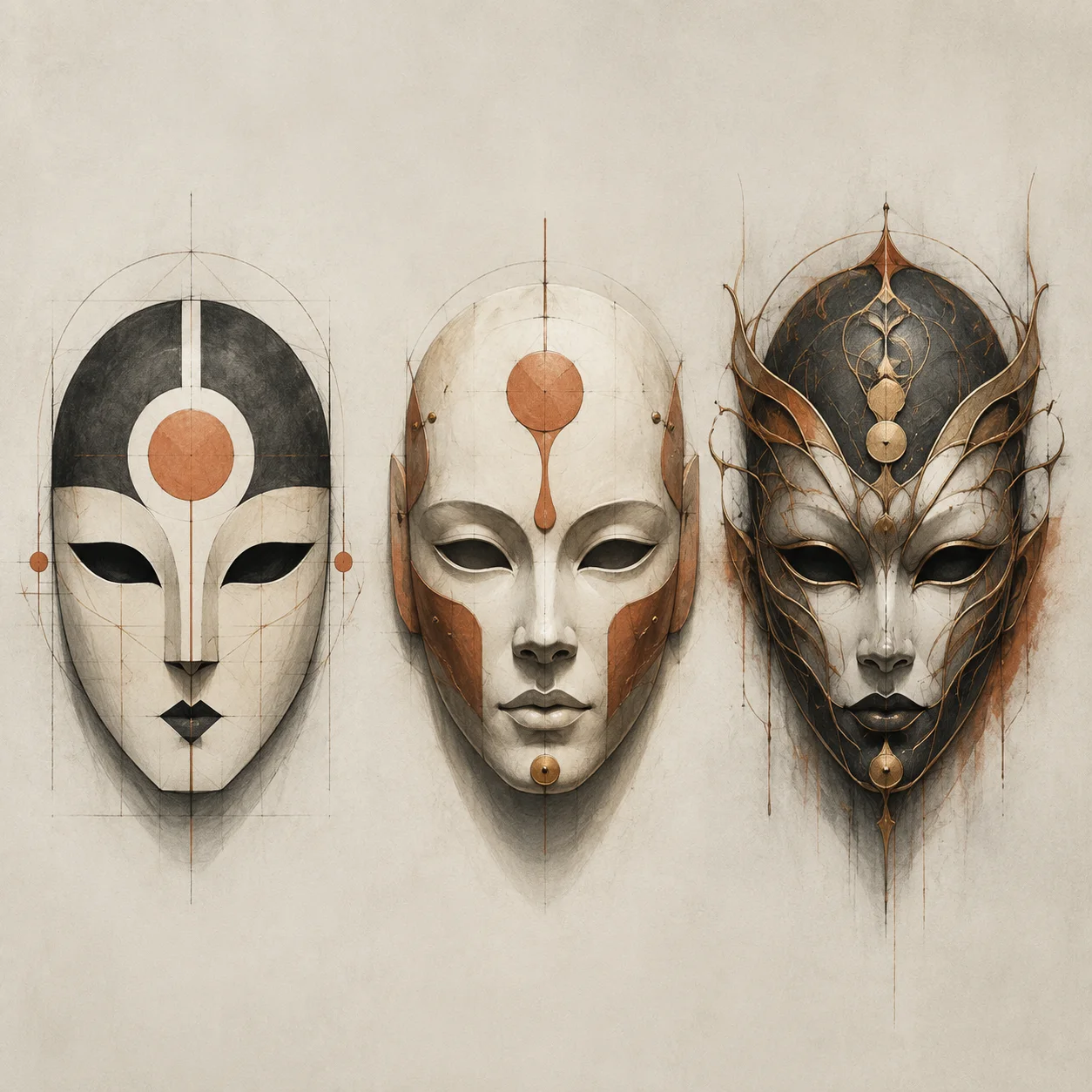
A weathered surface, symmetrical face or gilded line can make a new image feel old. That atmosphere is an artistic effect, not proof of date or origin. Responsible visual research begins by identifying the status of every reference: documented object, production record, secondary interpretation or contemporary invention. Keeping those categories visible protects both the reader and the cultures whose works might otherwise be reduced to a mood board.
Describe before you identify
Write only what the image supports: a frontal face, almond-shaped openings, a dark mottled surface, copper-colored lines and a circular frame. Avoid culture names, ritual functions and material claims unless a collection record or maker’s documentation confirms them. “Stone-like” describes appearance; “carved stone” asserts an object.
This method is especially important with AI-generated images. Models can produce plausible mixtures of forms without a real maker, site or provenance. The mask illustrations in this journal are fictional designs created for an editorial draft. They should never be uploaded elsewhere as museum photography or used to illustrate an undocumented tradition.
Use the object record as the anchor
A museum record may provide maker or attribution, place, date, medium, dimensions, accession number, provenance and bibliography. The Metropolitan Museum’s record for a portrait face mask from a mblo performance ties its description to a specific object and Baule performance context. Those details cannot be transferred to a visually similar contemporary mask.
Uncertainty must remain uncertainty. If a maker is unknown or a date is approximate, preserve the institution’s language. Do not “complete” the record by matching patterns across search results. Resemblance can guide further research, but it does not establish ownership, community meaning or historical contact.
Distinguish proposal, object and performance
A concept sketch records an intention. A fabricated mask records material decisions. A performance photograph records one event under particular light and movement. V&A materials on theatre collections and performance documentation show why these sources answer different questions.
The distinction also prevents a rendered digital prop from becoming fake product photography. Our warm stage study is an illustration of a possible object and lighting setup. It has no weight, wearer or conservation condition. Its value lies in testing visual relationships, not in pretending that fabrication has already happened.
Credit the modern work clearly
A useful credit names the work, production method, year and responsible rights holder. Until the publisher verifies the applicable licence and identity fields, the draft keeps those elements explicit and remains unavailable for indexing. This is more honest than attaching a fictional studio, designer or provenance.
If a future article reproduces a historical image, check the institution’s rights statement for that exact file. Public access to a record does not automatically grant commercial reuse of every image on the page. Keep the image credit beside the object, and keep the contemporary interpretation separate from the catalogue description.
Working takeaway
Classify each reference by what it actually is, preserve uncertainty, and never promote visual resemblance into provenance or cultural meaning.
Sources and scope
These references support the historical, collection and design framework. They do not endorse this publication or its illustrations.
- Victoria and Albert MuseumCostume — Explore the Collections
Overview of the V&A Theatre and Performance costume and accessory collections, spanning stage and screen practice.
- Victoria and Albert MuseumCapturing Performance
Curatorial explanation of how costumes, scripts, set designs, recordings and traces of use document performance.
- The Metropolitan Museum of ArtTerracotta Statuette of an Actor
Collection record for a Late Classical Greek actor statuette and evidence for recurring theatrical character types.
- The Metropolitan Museum of ArtStage Set Design for “The Mask”
Collection record for Erté’s 1926 stage design, useful as a documented example of a performance concept drawing.
- Victoria and Albert MuseumDisguising Degradation: The Treatment of a Latex Theatre Mask
A conservation case study showing why material, production evidence and condition matter when describing a physical theatre mask.
- The Metropolitan Museum of ArtPortrait Face Mask from a Mblo Performance
A specific collection record demonstrating why maker, place, performance context and provenance must come from documentation rather than appearance.